Tuesday, October 30, 2018

ARONE - The Startup with Drone Revolution in Nigeria

Emmanuel Ezenwere is the founder of Arone, a Nigerian startup that is changing the personalised drone delivery system in Nigeria, particularly in the area of healthcare. Ezenwere conceived the idea for Arone once he visited Lagos and met Temie Giwa-Tubosun, the founder of Life Bank, a startup working to improve access to blood transfusions in the country. “I started thinking about the impact it would have if we were able to assist them by using drones to deliver blood much quicker to people that need it so desperately. So that was when the idea came,” he told This Is Africa(TIA).
Arone Drone
Daily, hundreds of people, particularly women and children, die avoidable deaths due to a lack of access or untimely access to medical supplies. Approximately 1.6 million Africans die of diseases that can be prevented or treated with timely access to appropriate and affordable medicines, vaccines and other health services. Subsaharan Africa which accounts for over 50 percent of these deaths also has the lowest blood donation rates and poor accessibility to even the least available medical care.
Using a smart aerial logistics technology empowered with artificial intelligence and renewable sources of energy, Arone is bridging the gap between rural and urban health care centres by setting up drone delivery stations at blood banks and medical supplies distribution centres to provide a faster delivery of vital medical products to neighbouring rural and urban clinics on demand.
Arone’s team is made of six individuals with backgrounds in different tech fields including engineering, software development and design, all brought together by Ezenwere. According to him, he’d worked with them on previous projects hence when he conceived the idea for Arone, he reached out to them and they were just as excited as he was.
Regarding funding, Arone received about $5000 in March from three angel investors at the Roar Nigeria incubator at the University of Nigeria, Nsukka, where it’s currently incubating. According to TIA, a large percentage of that funding has been invested in obtaining the inventory and equipment for building drones, including a 3D printer for rapid prototyping.
Last month, Arone was selected to participate at the 38th GITEX Technology Week in Dubai, the biggest tech-startup event in MENA and South Asia with over 850 startups from 75 countries. Before that, the budding startup emerged the winner at the Slush Global Impact Accelerator (GIA) regional programme at the Heartland Incubation Hub in Owerri, Nigeria and will be representing Nigeria at the GIA finals in Finland, in December.
The goal for the startup is to take this impact technology to countries across Africa,  We plan to expand beyond Nigeria to countries such as Congo, Rwanda and beyond. So we expect to make a large number of life-saving deliveries each day. We really want to reduce the number of deaths caused by a lack of timely access to adequate medical supplies. We believe we can get it down to zero,” Ezenwere said.
Recently, the use of drones has become a global phenomenon in healthcare with the likes of American robotics company, Zipline, launching operations in Tanzania and Rwanda in the last two years. Dubbed “the Uber for blood” the company has recorded remarkable success delivering over 5,500 units of blood over the past year, often in life-saving situations.

Source: 

Africa awaits made in Nigeria armored personnel carriers


Nigeria’s Inspector-General of Police, Ibrahim Idris. Photo : PTN

Addis Ababa, Ethiopia (ADV) – The Nigerian government and a local vehicle manufacturing company are fine-tuning plans to build an armored personnel carrier, sources said Monday.
Nigeria’s Inspector-General of Police, Mr. Ibrahim Idris, made the revealation on Monday in Anambra State.
He expressed optimism that the plan with the Innoson Vehicle Manufacturing Co. Ltd. would come to fruition soon in a bid to successfully fight against crime.
The police boss made the statement when he addressed the inauguration of IVM Granite vehicle, 2019 edition.
Police Inspector Idris commended Innoson for providing camouflaged vehicles for the Nigerian Army to tackle insecurity.
In his remarks, the Chairman of Innoson Vehicle Manufacturing Company, Chief Innocent Chukwuma, said the company’s major strength depended on its ability to produce according to clients’ specifications.
“The fact that the Nigerian Police vehicle operate in diverse and dangerous terrains as a result of its functions, Innoson vehicles can produce specific operational vehicles that will meet the operational requirements of the Nigerian Police,” Chukwuma said.
A success in the adventure will certainly go a long way in encouraging other African governments in their bid to contain criminal acts, to put in orders for the Made in Nigeria armored personnel carriers.

© Bur-csa – A.H – N.A / From our regional correspondent Tamba Jean-Matthew III– African Daily Voice (ADV)

Gaddafi : Who Stole Libya’s Money ?


The mystery hangs over the funds placed by Libya and Colonel Gaddafi in Western countries and Africa. Photo: RR

NEWSROOM (ADV) – Seven years after the brutal assassination of Colonel Muammar Gaddafi by NATO forces, Libyan public funds in Western banks and Africa are fueling the debate.
Despite the war, Libya still holds the first oil reserves on the African continent, followed by Nigeria.
The country was until the fall of its leader, in October 2011, of the five main oil exporting countries in the world.
Thanks to oil revenues, Libya had accumulated enormous wealth. As a great visionary, Gaddafi wanted to secure these assets to ensure the future of the Libyan people.
He had therefore placed these assets in investment companies to buy stakes in the largest multinationals.
The new Libyan authorities – yet recognized by NATO – are struggling to recover their fortune from abroad.
Where did the Libyan people’s money go ? Why does France, the United States, Great Britain, and even some African countries refuse to return them to Libya ?
Explanations…

Monday, October 29, 2018

Russia To Host Russia-African Union Forum 2019

By Kester Kenn Klomegah
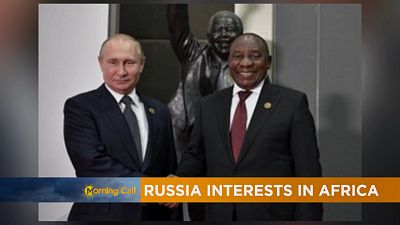
Image result for russia africa
Faced with persistent criticisms, Russia has finally announced it will most likely host the first high-level Russia-African Union forum next year, a replica or a carbon copy of Forum on China Africa Cooperation (FOCAC) or European Union–African Union summit, signaling its readiness to work towards deepening and strengthening multifaceted engagement with Africa.
Working on a new paradigm collaboratively with African Union, Russia hopes to fill up pitfalls and cracks in the existing relationship, reinforce diplomatic ties and raise its staggering economic profile on the continent similar to the levels of China, India, Japan, South Korea, Turkey, U.S. and Europe.
On his official visit to Rwanda early June, Foreign Affairs Minister Sergey Lavrov hinted that the forum rolls out a comprehensive strategic roadmap for more economic cooperation and wide-range of investment possibilities, find effective ways of addressing regional security issues and that of improving public diplomacy in Africa.
“We discussed Russia’s idea of holding a large African Union business forum with AU member states and Russia to be attended by entrepreneurs and politicians, possibly next year,” Lavrov said at a media conference after meeting with Minister of Foreign Affairs, Cooperation and East African Community Louise Mushikiwabo in Kigali, Rwanda.
“We have agreed to prepare a framework political document that will set out a concept for cooperation in the next few years and also several practical projects for implementation in the near future. We are now preparing for a meeting of Russian and AU experts,” he assertively added.
Just before his African tour early March, Lavrov also told Hommes d’Afrique magazine “we carefully study the practice of summits between African countries and their major partners abroad. At present, Russia’s relations with African countries are progressing both on a bilateral basis and along the line of African regional organisations, primarily the African Union and the Southern African Development Community.”
In the interview posted to MFA website, he said “our African friends note the need for Russia’s active presence in the region, and more frequently express interest in holding a Russia-African summit. Such a meeting would undoubtedly help deepen our cooperation on the full range of issues. However, it is necessary to bear in mind that arranging an event of such a scale with the participation of over 50 Heads of State and Government requires most careful preparation, including in terms of its substantive content.”
Lavrov acknowledged in the interview: “The economic component of the summit has a special significance in this relation as it would be of practical interest for all the parties. As such, specific Russian participants in bilateral or multilateral cooperation should be identified, which are not only committed to long-term cooperation but are also ready for large-scale investments in the African markets with account of possible risks and high competition. Equally important are African businesspeople who are looking to work on the Russian market.”
On May 16, Lavrov chaired the Foreign Ministry Collegium meeting on the subject “Cooperation with Sub-Saharan African countries as part of implementing important tasks of Russian foreign policy.” The meeting noted that the consolidation of versatile ties with the Sub-Saharan African countries remains a major part of Russia’s foreign policy strategy, which is acquiring special significance in the context of deep changes in the global arena.
Some experts and researchers have, of course, identified low enthusiasm and lack of coordinated mechanism as key factors affecting cooperation between Russia and African countries, and suggested that this trend could be reversed if both Russian authorities and African governments get down regularly to serious dialogue with concrete business agenda.
Nearly a decade ago, Themba Mhlongo, Head of Programmes at the Southern Africa Trust, said in an emailed interview that “there is no effective Russia-African dialogue or mechanism for dialoguing with Africa. On the other hand, Russia has not been as aggressive as China in pursuing opportunities in Africa because Russia has natural resources and markets in Eastern Europe, South West Asia. Russia’s key exports to Africa might only be dominated by machinery and military equipment which serves their interest well.”
He suggested that Africa must also engage all BRICS members equally including Brazil and Russia in order to build alliances and open trade opportunities including finance and investment opportunities, African countries must not seem to show preferences in their foreign policy in favour of western Europe if they want to benefit from trade relations with Russia.
Tellingly, Vadim Trofimovich Kirsanov, an African Affairs Advisor at the Regional Projects Department of Russkiy Mir Foundation, (non-profit Russian NGO that promotes Russian language, literature and culture abroad), in an interview with Buziness Africa media, discusses the significance of developing bilateral ties not only in economic sphere but also in culture, exchange of people and ideas in the social sphere.
“We must use the full potential interest in Russian culture, Russian language, mutual sympathy and interest between the peoples of Africa and Russia, a great desire of Russians and Africans to visit each other to make friends, establish new connections. That’s where public diplomacy becomes an effective instrument for supporting business dialogue,” he said.
Kirsanov noted: use new opportunities for mutually beneficial cooperation open to the accession of South Africa to BRICS group (Brazil, Russia, India, China and South Africa), taking into account the economic impact of South Africa on the African continent and the world at large. Besides the intensification of dialogue with the African Union (AU), the Russian authorities have the development of multilateral cooperation among African countries with Russian Federation.
Professor Gerrit Olivier from the Department of Political Science, University of Pretoria in South Africa, noted that Russian influence in Africa, despite efforts towards resuscitation, remains marginal. While, given its global status, it ought to be active in Africa as Western Europe, the European Union, the United States and China are, it is all but absent, playing a negligible role.
“Russia, of course, is not satisfied with this state of affairs. At present diplomacy dominates its approach: plethora of agreements have been signed with South Africa and various other states in Africa, official visits from Moscow proliferate apace, but the outcomes remain hardly discernible,” Professor Olivier, previously served as South African Ambassador to the Russian Federation, wrote in an email comment from Pretoria, South Africa.
Be as it may, he indicated further that “the Kremlin has revived its interest in the African continent and it will be realistic to expect that the spade work it is putting in now will at some stage show more tangible results.”
In his assessment, Rex Essenowo, a Moscow-based Economic Policy Analyst, pointed out to a known and well-established fact, which Russians have always shrugged off, that there have been many summits and conferences between the United States, EU and Asian states with Africa, but there has yet to be a single high-level Russia-African summit.
However, he believes that all was not yet lost, there is still an unexplored chance to strengthen Russia’s relationship with Africa if, for example, African countries work collectively together as AU to focus on improving all aspects of Russia-African relationship.
Large investments and comprehensive approach, similar to the Chinese, would help to bridge the economic and political gap between Russia and the African continent, Essenowo said, and reminded that Russia is very much involved in educating and/or training professionals who are playing key roles and could serve as excellent useful links between Russia and Africa. Russia has ignored this valuable product in its diplomacy with Africa.
Interesting, BRICS countries are vigorously moving into Africa and now three BRICS members: Russia is planning, India and China are also preparing for summits next year with Africa. As already publicly known, all previous summits held by many foreign countries with Africa, there were concrete financial packages earmarked towards infrastructure development in Africa.
From Russia’s perspective, there are undeniable important geopolitical implications working with Africa. Nevertheless, Russia’s efforts in the region have been limited thus far which some experts attributed to lack of a system of financing policy projects. While Russia government is very cautious about making financial commitments, Russia’s financial institutions are not closely involved in foreign policy initiatives in Africa.

Experts and researchers have recommended one new initiative that will largely interest African leaders, that is for Russia to create a Russian Development Fund for Africa (RDfA) as an agency to manage and run projects as business for Russia in Africa while Russian International Affairs Council (RIAC) could become the key organiser and coordinator of future Russia-African Union summits. Kester Kenn Klomegah frequently writes on Russia, Africa and BRICS.

Russia-Africa Social Forum

By
 

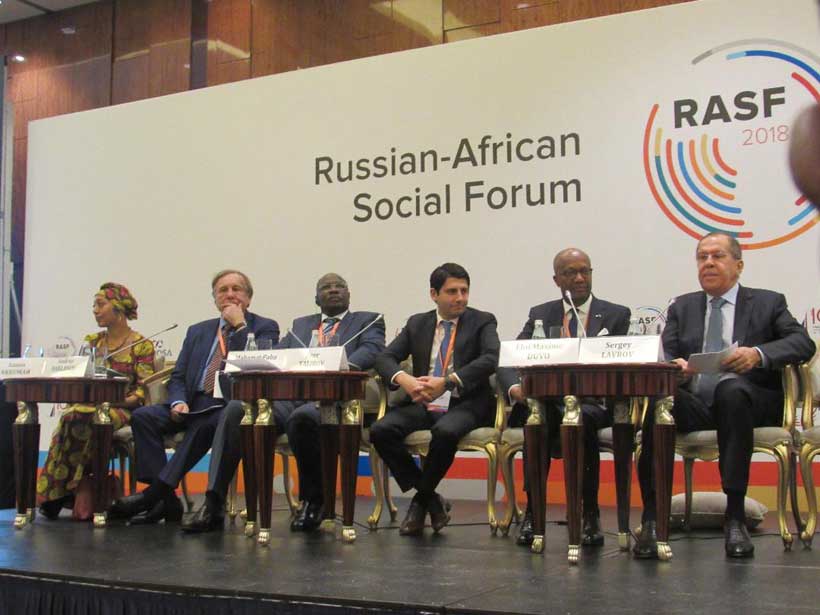
On October 22, the first Russia-Africa Social Forum, organised jointly by the World Association of Foreign Alumni of Russian Universities and African Business Initiative Union, was held in Moscow. More than 500 people participated: prominent Russian and African political and public officials, representatives of academic circles, the business community, and representatives of student and youth organisations.
The event provided a unique platform to exchange views on the current issues of relations between Russia and African countries, the current state of relations and the prospects for further development in the political, trade, economic, humanitarian and cultural fields, among others.
In his address as a keynote speaker, Foreign Minister Sergey Lavrov acknowledged the significance of the forum and stressed that it would be impossible to elevate the entire range of relations between Russia and African countries to an entirely new level unless the public at large takes the most energetic part in these efforts.
It is hard to overestimate the role of this in strengthening friendship, trust and mutual understanding between nations. For example, many Africans have discovered modern Russia for themselves while taking part in the 19th World Festival of Youth and Students in Sochi in the autumn of 2017 or while visiting Russia as fans during the 2018 FIFA World Cup.
Lavrov therefore considered absolutely necessary to maximise the potential of public, cultural and business diplomacy in the interests of strengthening and expanding the mutually beneficial ties between Russia and Africa.
“This is a wonderful opportunity to discuss topical issues of Russian-African cooperation and to outline specific and forward-looking aspects of cooperation and joint work,” said Lavrov.
As already known, Africa is an important partner for Russia, a participant in the emerging and sustainable polycentric architecture of the world order. Russia’s relations with African countries are valuable in their own right and should not be subject to the fluctuations on the international arena.
“We maintain regular contact at the highest and higher levels. Relations between our parliaments, as well as the exchanges between our respective ministries and departments, including, of course, foreign ministries, are expanding. Trade and economic exchanges are improving, although not at the pace we would like to see. Projects in the military-technical sector, as well as programmes in healthcare, education, and culture are underway,” according to the Foreign Minister.
He further noted that the positions of Russia and the overwhelming majority of African countries on the key issues are similar or very close. Both Russians and African friends are consistent supporters of strengthening democratic and just principles of international life, respect for the cultural diversity of the modern world, and the right of the people to determine the models and approaches to socioeconomic development.
Moscow is interested in close foreign policy coordination with its African partners in the UN and other multilateral venues. In particular, Russia supports further deepening of the BRICS-Africa dialogue.
It also attaches great importance to strengthening peace and security in the region that is the most important component in ensuring the sustainable and dynamic development of the African states and maintaining global and regional stability. As a permanent member of the United Nations’ Security Council, Russia continues to contribute to the development of a strategy for practical peacekeeping operations on the continent, while invariably adhering to the African solutions to African problems principle formulated by the Africans themselves.
As further steps to upgrade its cooperation with African countries in this era of keen competition and globalisation, Russia plans another opportunity to take stock of its current efforts, explore the possibilities and constraints in promoting concrete economic cooperation by hold a Russia-Africa inter-parliamentary conference and a business forum in the near future.
The first Russia-Africa inter-parliamentary conference and a special mini business forum under the theme “Russia – Africa: Horizons of Cooperation” was held on June 15, 2010. It included workshops and round tables by business representatives from Russia and African countries, and an exposition of the leading Russian enterprises and regions connected with development of economic cooperation with Africa.
The forthcoming conference and forum are within the context of preparing for the first Russia-Africa Summit, the importance of which President Vladimir Putin stressed during the 10th Anniversary BRICS Summit in Johannesburg in July.

West Africa loses $2bn annually to illegal fishing


THE Gulf Of Guinea Commission has disclosed that West Africa is losing about $2bn annually from illegal fishing.
The Executive Secretary of the Commission, Amb. Florentina Ukonga made this disclosure on Monday at the Gulf Of Guinea Conference on the maritime sector, held in Lagos.
The Secretary, who announced that this year’s second seminar of the Gulf Of Guinea Commission is entitled “The Blue Economy in the interest of Food Security in the Gulf Of Guinea Region”, said that the largely underdeveloped and poorly governed state of the coastal region is a major drawback.
“While other countries and regions are reaping the benefits and returns from the blue economy, West Africa, for example, is estimated to be losing about $2billion annually from illegal fishing.
“It’s coastal sector remains largely underdeveloped and poorly governed, which has enabled other forces from outside the continent that benefits more from it, than its citizens.
illegal fishing“Approximately, 57 per cent of fish stocks are fully exploited and another 30 per cent is over-exploited, depleted or recovering,” Ambassador Florentina Ukonga stated.
She, however, charged member states to collectively resolve increasing pressures faced by seas and oceans.
The Secretary added that the maritime domain cannot be managed individually because of the inter-connectivity of maritime activities amongst various organizations.
“Our seas and oceans are facing increasing pressures from both within and outside the region and it is in our own interest to deal with these pressures through collective efforts.
“No individual State can effectively and prudently manage its maritime domain. We must collectively, continue to manage the human activities that are negatively affecting our seas and oceans.
“The collaboration and cooperation amongst the States of the region are very important because of the interconnectivity of maritime activities, as generally there is often lack or non-existent of coordination amongst various organizations that are responsible for the seas and oceans in the region,” she added.


Sunday, October 28, 2018

Ghana's Economy Now Worth GH256bn After Rebasing

  • By REX NADER
    • Related image
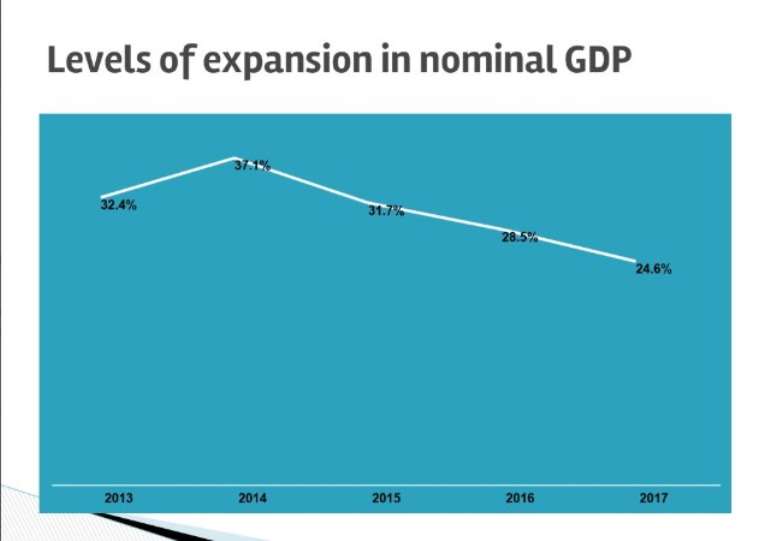
    • Ghana’s economy has expanded by 24.6 per cent for last year, according to rebasing figures by the Ghana Statistics Service (GSS).
      This was after the GSS reviewed the based year from 2006 to 2013 and the way of calculating economic growth for the country.
      The revision should mean that the new growth rate for 2017 stands at 8.1 per cent compared to an old rate of 8.5 per cent.
      However, the GSS says this does not mean that growth has declined because the base of the economy has expanded.
      The value of the economy and per capita
      The economy is now worth GH₵256 billion as a result of the rebasing. If this is shared among a population size of 28.96 million, then everyone could get GH₵8, 863.
      Why rebasing
      Rebasing of national accounts series means that they are replacing the old base year used for compiling the constant price estimates to a new and more recent base year.
      According to the Ghana Statistical Service, there are three main reasons for the change in the rebased GDP coverage. This includes Methodology, Structural and Coverage.
      The change in the base year has also been influenced by a change in the structure of the economy since 2006. Some activities which had little economic importance in 2006 have gained prominence now and may contribute more to the economy than before.
      Sector break down for 2017
    • 928201870613 0g830m4yyt 648489977957 1042269420654
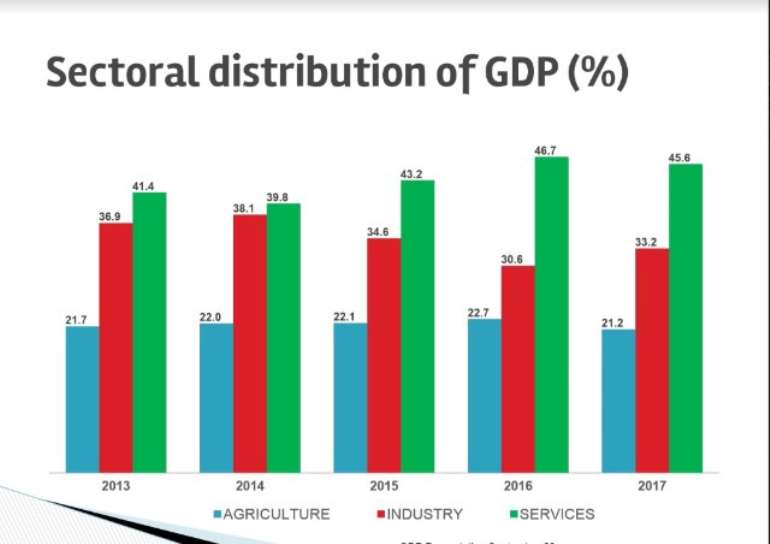
    • Based on the rebased GDP, the Services sector grew by 3.3 per cent in last year, industry by 15.7 per cent and Agric by 6.1 per cent. This means that industry recorded the highest growth in the economy in 2017.
    • 928201870614 l5grj7u3i1 3697771163243 6733084498594
    • Which sector has the largest share of the economy?
      Base on the rebasing, activities in the Agric sector now accounts for 27 per cent of the economy, Industry 36 per cent, while services still led the pack with 41 per cent.
      Implications
      The development would affect Ghana’s debt to GDP ratio, meaning that government may have to increase tax collections to make for the expected shortfall.
      According to think tank, Center for Economic studies;
      - Short-term revenue performance measures by the government could mean upward review of taxes in the 2019 budget.
      - Grants in aid of vulnerable sectors of the economy could dip further as has been the case post middle income status, coupled with exit signals from the donor community premised on government's undocumented policy of "Ghana Beyond Aid".
      - The tendency to interpret higher per capita income as a true reflection of improved livelihoods could provoke public anger.
      The Centre for Socioeconomic Studies (CSS), guided by these facts, believes that the post-rebasing focus of government should be on fiscal prudence through improved tax and non-tax revenue performance to spur productive expansion of the Ghanaian economy and accommodate the high expenditures building from numerous manifesto promises.

    Africa: Kagame Seeks Continental Parliament's Help in AfCFTA Ratification Campaign


    Rwandan President Paul Kagame has called on the Pan African Parliament to help speed up the ratification of the African Continental Free Trade Agreement (AfCFTA) by member states.
    The AfCFTA is the world's largest bloc, estimated to bring about long-term gains of about $16 billion annually to the continent through the elimination of tariffs, free movement of people and goods across the continent.
    In his address to the First Ordinary Session of the Fifth Pan African Parliament, President Kagame, who is the African Union chairman, asked the legislators to exploit their dual roles to become advocates of African integration in their countries and at the continental legislature.
    "I ask for your support for the speedy ratification of the CFTA, the Protocol on the Free Movement of Persons, and other key pillars of Agenda 2063. The entry into force of these historic pacts will do more to accelerate economic growth on our continent. We cannot afford to squander the momentum we have gained," he said.
    "But we need your help to communicate more effectively with constituents and stakeholders about the importance of these agreements for the well-being of our citizens and economies."
    So far, 48 countries have signed the AfCFTA, with South Africa, the latest, signing in July.

    President Kagame said that the African Union is financially healthier than before, having slashed its annual budget by 14 per cent, with more member states contributing their share of funds.
    "Important changes are underway on our continent, and in the wider world, and we have to be ready to meet them. Working together is the only way to give Africa's position the weight it should have in the wider geopolitical context," he said.
    "We must meet the imperative of good governance, with innovations and solutions drawn from Africa's rich experiences and cultures, even as we remain open to benefiting from the best global insights."
    The President of the Pan African Parliament Roger Nkodo Dang emphasised the need to fight corruption for regional integration to work.
    "Corruption is a challenge that we should all be concerned about. It is up to us as legislators to work hard and fight against this evil that leads to poverty and underdevelopment," he said.
    According to the United Nations, Africa loses $50 billion annually in illicit capital flows aided by corruption.

    Africa

    Scientists Support Use of HIV Drug Linked to Birth Defects in Babies
    Researchers have warned countries against stopping the use of a drug linked to birth defects in HIV-positive women. Read more »

    Corporate Council on Africa Set to Host U.S.-Africa Infrastructure Innovation Conference in Johannesburg, South Africa, Nov 5-6, 2018

    Corporate Council on Africa (CCA), the leading U.S. business association focused solely on connecting business interests in Africa, will host its 8th U.S.-Africa Infrastructure Conference November 5-6, 2018 in Johannesburg, South Africa. CCA is expecting over 300 U.S. and African participants, including innovative businesses and service providers, financiers, investors, private sector executives and government representatives to participate in this essential conference.
    The African Development Bank estimates in its 2018 Africa Economic Outlook reports that the continent needs at least $130 billion a year in infrastructure development per year for at least the next decade to meet the needs of rapidly growing, increasingly urban countries. The sheer scope of the needs and the pace of population growth will demand innovation across the project cycle to be successful.
    CCA's conference will introduce innovative solutions in a range of sectors including ICT, energy, transportation, health and finance to African government and private sector actors and offer insights on novel approaches that infrastructure leaders have implemented to make ambitious projects a reality.
    Attendees will hear from leading U.S and African industry experts on innovative technologies and solutions to infrastructure needs on the continent; Gain access to key U.S. and African government officials and decision makers driving infrastructure investment on the continent; Connect with U.S. and African business decision-makers from C-suite to business development and identify new business partners and investors; Obtain real-time business and investment leads that can result in sales and contracts; Showcase their company's innovative solutions in infrastructure to leading businesses and key government officials
    The conference will also feature an exhibition center, which will allow businesses to display current and successful projects, initiatives or products that are presently being used to close the gap in infrastructure development.  Dedicated time will be scheduled for conference participants to meet project representatives and hear short presentations on the highlights of their technology or project.
    The 2018 U.S.-Africa Infrastructure Conference is proudly sponsored by leading American and African businesses and organizations including: Acrow Bridge, AllAfrica Global Media, Barloworld Namibia(pty) Ltd, Caterpillar, Inc., Chevron Corporation, Citi, Covington and Burling LLP, Global Agri. Exchange (GAEX), Lockheed Martin, and South African Airways.
     
    Learn more, View agenda and confirmed speakers, and Register on the conference website here

    Friday, October 26, 2018

    Ethiopia's visa-on-arrival for all Africans starts November 9

    Abdur Rahman Alfa Shaban

    Ethiopia's visa-on-arrival for all Africans starts November 9
    A hint from the Prime Minister in May 2018, then a confirmation of implementation by erstwhile president. In between both, the country began issuing visas online to tourists.
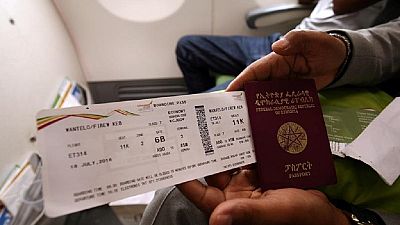
    Finally, Ethiopia has announced a date for the start of a visa-on-arrival regime for all Africans. Africa’s second most populous nation will start visa-on arrival regime from November 9, 2018, PM Abiy Ahmed’s chief of staff confirmed on Friday.
    According to Fitsum Aregaa, the current move is: “Consistent with PM Abiy Ahmed’s vision of a closer and full regional integration in Africa — where minds are open to ideas and markets are open to trade.”
    Abiy had earlier this year disclosed that following Rwanda’s lead, Ethiopia was going to allow a visa-free regime for all Africans. At the time, he was speaking at a state banquet held for his visiting Rwandan counterpart, Paul Kagame.
    Abiy said: “The President (Kagame) invited all Africans to travel to Rwanda without visas, we will follow you very soon.” On June 1 the issuance of visas online for all tourists kick started.
    Ethiopia boasts the continent’s best national carrier, Ethiopian Airlines, which has made the Bole International Airport in Addis Ababa, not just a regional but global aviation hub.

    The most recent time the issue was came up was when ex-president Mulatu Teshome at the opening of parliament said the visa-on-arrival regime was to be implemented in this year.
    Source: AfricaNews

    Thursday, October 18, 2018

    HACKFORGOOD 2018 – TRANSFORMING THE CONTINENT’S NARRATIVE FROM AID TO AFRICA TO MADE IN AFRICA


    The  Youth for Technology Foundation (YTF) recently hosted it’s annual 3D Africa HackforGood event, a design and prototyping challenge, from Thursday, August 2, 2018, to Saturday, August 4, 2018, at the University of Lagos. For three days, 50 young hackers from across Nigeria comprising students, recent graduates and early-stage entrepreneurs, were given access to cutting-edge technology, mentoring and instruction to develop functional prototypes to address issues in their communities.

    Divided into eight teams, the participants conceived ideas and developed prototypes to solve problems in specific sectors, namely health, agriculture, security, and transportation with the help of a 3D printer. These prototypes were pitched to a jury and judged on the criterium of impact, technology, marketability, and collaboration in terms of teamwork and the pitch.
    The HackforGood teams, 2018
    Team Alpha developed a Gesture Controlled Pesticide Spraying Robot (GCPSR) for farmers. The idea and the reason behind it is to reduce health risks for farmers by providing them with a better alternative to spraying insecticides, and also to get this done faster. Team Alpha created a robot that detects lines and motions and a glove to control it, to be worn by the farmer. This robot detects lines and motions and can be programmed to deal with insect invasion even when the farmer is not there. Their prototype addresses problems in both health and agriculture. 
    Team Rex created the Smart Pathfinder for the blind, an obstacle detecting device that works with a Bluetooth. Apparently, the device, an improvement on the white cane, is developed to aid visually impaired individuals. And also, as the team explained, to help make life easier for those ladened with the responsibility of aiding them. This compact device with ultrasonic sensors only has to be attached to the blind stick/white cane already owned by a visually impaired individual to be used. Team Rex hopes that the device can be modified in the future to include a GPS tracker and be voice automated.
    Team De-void developed a Car Intelligence Security System (CISS) that tackles the problems of car hijacking on the highway. CISS alerts vehicle owners of hijacking incidents in real time. It tracks the car’s location and speed and finally makes it possible to remotely render the car inactive. The device also detects potholes and bumpy areas on highways and visualizes them on a heat map to show susceptible areas simultaneously. CISS utilizes the data of time and locations where car hijackings happen most frequently to intelligently predict red zones and inform vehicles owners of what areas are dangerous and how best to plan their trips.
    Team Explore created the Agrofast alert, a device for farmers that connects to a platform where they can get their farm produce down to the consumers faster, cheaper and comfortably through freight services by connecting
    them to the retailer with just a click of a button. As explained by the team, farmers in rural communities are rarely tech savvy and unable to use a smartphone. The device created by the team only requires farmers to push a button and customers in the city will be notified to go pick up freshly harvested produce.
    “The idea behind this device is to speed up the food chain process and to help farmers prevent loss or waste. So many farmers lose money from having their produce go bad, especially since they have no storage facilities for their perishable produce.” The device which can be worn on the arm or around the neck is made with an Arduino Uno microcontroller, a sim808 GSM GPS module, LED and buzzer. 
    Team IHack developed a fruit scanner that is able to detect spoilage in fruits and vegetables using parameters such as temperature, light, humidity and enzyme activities. The scanner was created using the Arduino UNO board and other incorporated sensors like DHT11 for temperature, LDR for light intensity, MQ3 for alcohol content and LCD. The device seeks to optimize the hygiene of fruits and vegetables, as well as sales by reducing wastage. It also reduces the risk of food poisoning caused as a result of deterioration in fruits and vegetables.
    Team Visioneers developed a smart glass and walking aid for the visually impaired. The smart glass converts text to speech to aid with reading, while the walking aid, a handheld device acts as a guide by vibrating when obstacles are detected. “The prototype targets the health sector in the sense that we are looking at helping the visually impaired to read and walk about in the house and on the street without bumping into obstacles thereby boosting their confidence like every normal person,” the team explained.
    Team Pentacorp created a Smart Monitoring System (SMS)a device that detects gas leakage in homes while monitoring intrusion incidence. When the SMS is installed and activated, the sensors become operative. If a gas leakage occurs, the sensor detects it, an LED display comes on periodically while the buzzer sounds an alarm, and a notification is sent to the owner’s phone and the fire service. All this happen simultaneously and in real time. The same sequence follows in the case of a break-in however, the notification will be sent to the security operatives and not the fire service.
    Team Gamma-Torch created ChangeMi, a Radio Frequency Identification (RFID) technology that solves the problem of unavailability of change in the transportation system. “Seven out of 10 drivers have either had to forego their balance; or engaged in altercations with commuters over the unavailability of change consequently resulting in traffic and loss of time,” team gamma-torch explained. “Our device allows a driver to give an encrypted card, “ChangeMi”, that can be reused some other time with a different cab or driver.”
    The cards can be converted to cash through direct debit into the commuter’s account and will be in different denominations.
    At the end of Saturday, Team Rex emerged as winners of the competition with their Smart Pathfinder. The team left with a prize money of $1500, an equivalent of over N500,000.
    Speaking to Ventures Africa during the ‘Hack till you drop’ session, Day 2 of the event, Emmanuel Odunlade, past winner, and current mentor at the event said he is impressed with the ideas and the prototypes that the teams came up with. “Many of the participants have quite the vision and it almost seems like fantasy, but it is great to witness where their minds can take them.” He also encouraged them to come up with sustainable solutions that can be built on post the HackforGood event. “One thing I always tell them is that whatever they develop, they should develop with thoughts beyond the event. They shouldn’t come up with lofty ideas just to win the prize,” he said.
    3D Africa HackforGood is the only fourth industrial revolution technology platform that is built on a collaboration between the private sector, academia and civil society. This threefold relationship places YTF in a position to deliver hands-on experience with relevant technology and teach skills linked directly to industry needs and demands. The event provides African youths with the opportunity to create the world’s next best innovation, transforming the mindset and narrative from aid to Africa to made in Africa.


    A Window Opens in Business Ties Between Russia and Nigeria

      Rex Essenowo's Post: By God's grace, I began this month of December with this interview! This time last year, we all whished that ...